
Breathing Techniques for Stress & Panic Relief: Natural Ways to Calm Your Mind and Body
Introduction
Your heart starts racing… your chest feels tight… and suddenly, your breath becomes shallow and fast.
Why does this happen?
And more importantly—why does something as simple as breathing suddenly feel so difficult?
What if the very thing you’re struggling with… is also the key to calming everything down?
Many people don’t realize this:
Your breath is directly connected to your nervous system—and learning to control it can shift your entire mental state within minutes.
Is This Common or Normal?
You’re not alone in this.
In fact, millions of people worldwide experience stress, anxiety, and panic symptoms—often without fully understanding what’s happening inside their bodies.
This is more common than most people think.
Modern lifestyles—constant screen time, irregular sleep, work pressure—keep the body in a subtle “alert mode.”
Many readers tell us they feel:
-
- Restless without a clear reason
- Unable to take a full, satisfying breath
- Sudden waves of panic or uneasiness
And here’s something reassuring:
Your body is not malfunctioning—it’s reacting.
👉 If stress and anxiety are becoming frequent, this in-depth guide can help you understand natural solutions: Natural Remedies for Stress and Anxiety
Causes of Stress & Panic
What Actually Triggers Stress & Panic Episodes?
Many articles skip this—but this is exactly what users are searching.
Sometimes the trigger isn’t obvious.
You may have noticed:
- Anxiety appears “out of nowhere”
- Breathing suddenly becomes shallow
- Body reacts before thoughts do
Common Root Causes
1. Chronic Stress Build-Up
Small daily stressors accumulate silently.
What really happens if stress is never released?
It starts showing up physically—through breath, heart rate, and tension.
2. Caffeine & Stimulants
Especially relevant in India where tea/coffee is frequent.
- Increases heart rate
- Mimics panic symptoms
3. Poor Sleep Quality
Sleep deprivation heightens nervous system sensitivity.
4. Sedentary Lifestyle
Less movement = reduced oxygen efficiency.
5. Emotional Suppression
Unprocessed emotions often surface as anxiety.
Here’s What’s Really Happening Inside Your Body…
Breathing is not just about oxygen—it’s a control switch for your nervous system.
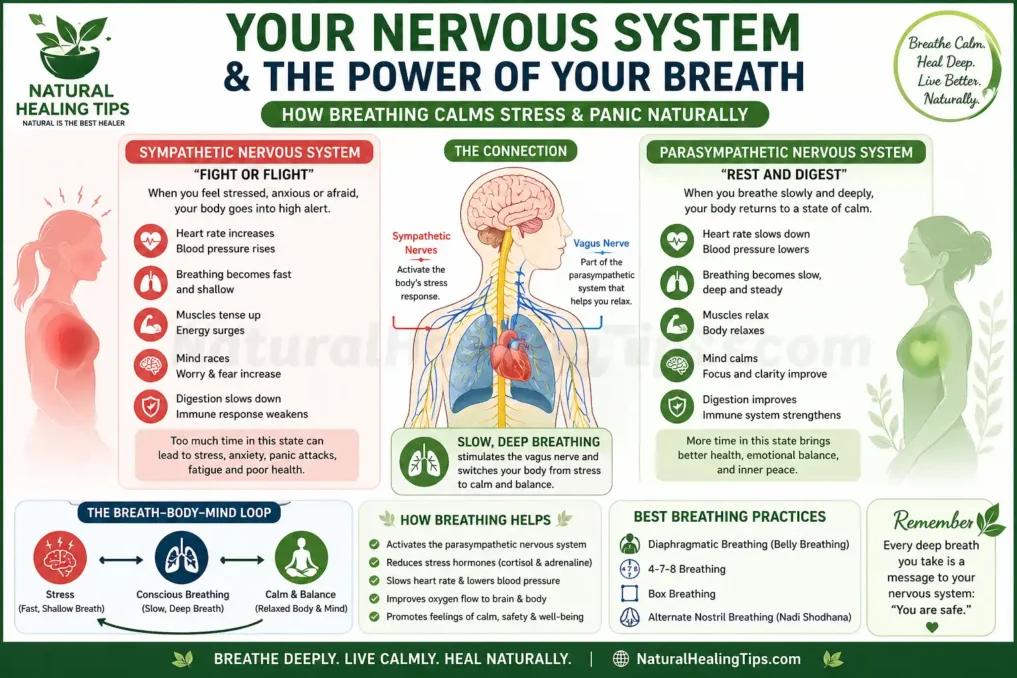
Let’s break down the key mechanisms.
1. Autonomic Nervous System Imbalance
Your body has two modes:
- Sympathetic (fight or flight)
- Parasympathetic (rest and digest)
Stress pushes you into constant “fight mode.”
Slow breathing activates the calming system.
2. Oxygen–Carbon Dioxide Imbalance
During anxiety, people often over-breathe (hyperventilate).
This reduces carbon dioxide levels, leading to:
- Dizziness
- Chest tightness
- Tingling sensations
Controlled breathing restores balance.
3. Heart Rate Variability (HRV)
One interesting thing researchers have found:
Slow breathing improves HRV, which is linked to better stress resilience.
Higher HRV = better emotional control.
4. Cortisol Regulation
Stress increases cortisol (stress hormone).
Breathing exercises help regulate cortisol levels over time.
5. Brain Signaling (Vagus Nerve Activation)
Deep breathing stimulates the vagus nerve.
This signals the brain:
“You are safe.”
And your body responds accordingly.
6. Panic Feedback Loop
Panic feeds itself:
- Fast breathing → fear
- Fear → faster breathing
Breaking this loop with breathing is one of the fastest interventions.
↗ Clinical experts at Mayo Clinic explain how breathing directly affects anxiety and panic responses.
Symptoms Mapping
Stress vs Panic Attack: How to Recognize the Difference
You may not notice it, but your breathing pattern changes dramatically during panic—and this visual makes it clear
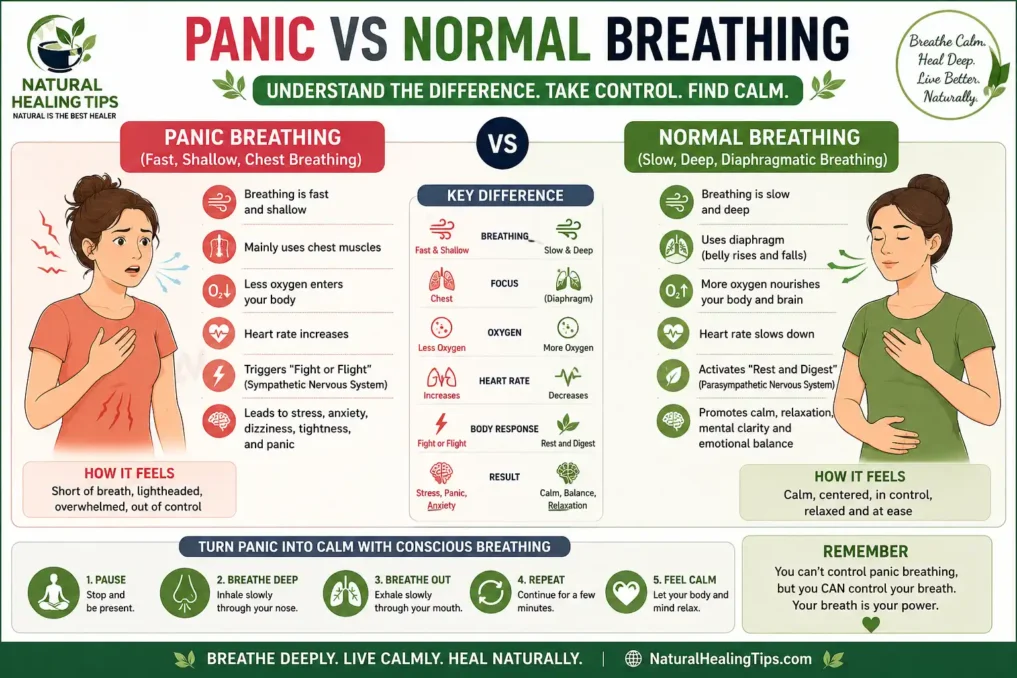
This section captures high search intent queries.
| Symptom | Stress | Panic Attack |
|---|---|---|
| Breathing | Slightly fast | Rapid, shallow |
| Heart rate | Elevated | Racing |
| Duration | Hours/days | 5–30 minutes |
| Trigger | Known | Often unknown |
| Intensity | Mild–moderate | Intense |
Hidden Symptoms People Ignore
Many readers tell us they experience:
- Frequent sighing
- Yawning excessively
- Tight throat sensation
- Air hunger (feeling you can’t get a full breath)
These are often early breathing dysfunction signs—not serious illness.
Common Mistakes
Why Breathing Techniques Sometimes Don’t Work
This is a major ranking gap most sites miss.
1. Breathing Too Fast
Trying to “fix” breathing quickly makes it worse.
2. Forcing Deep Breaths
This can increase dizziness.
3. Practicing Only During Panic
Big mistake.
Breathing training works best when practiced during calm states.
4. Ignoring Posture
Slouched posture = restricted lungs.
When Should You Be Concerned?
While this is usually harmless, there are times when you should pay attention.
According to organizations like World Health Organization, NHS, and Mayo Clinic:
Seek medical advice if you experience:
- Frequent panic attacks without triggers
- Chest pain that doesn’t ease with rest
- Severe breathlessness
- Fainting episodes
- Anxiety affecting daily functioning
Breathing techniques are powerful—but not a replacement for medical care when needed.
↗ For a global perspective on stress and mental health, refer to guidelines by World Health Organization on managing stress effectively.
The Good News Is—Small Changes Can Make a Noticeable Difference…
Let’s move into what actually works.
These are not generic tips—they’re practical, tested techniques.
10 Powerful Breathing Techniques for Stress & Panic Relief
1. Diaphragmatic Breathing (Belly Breathing)
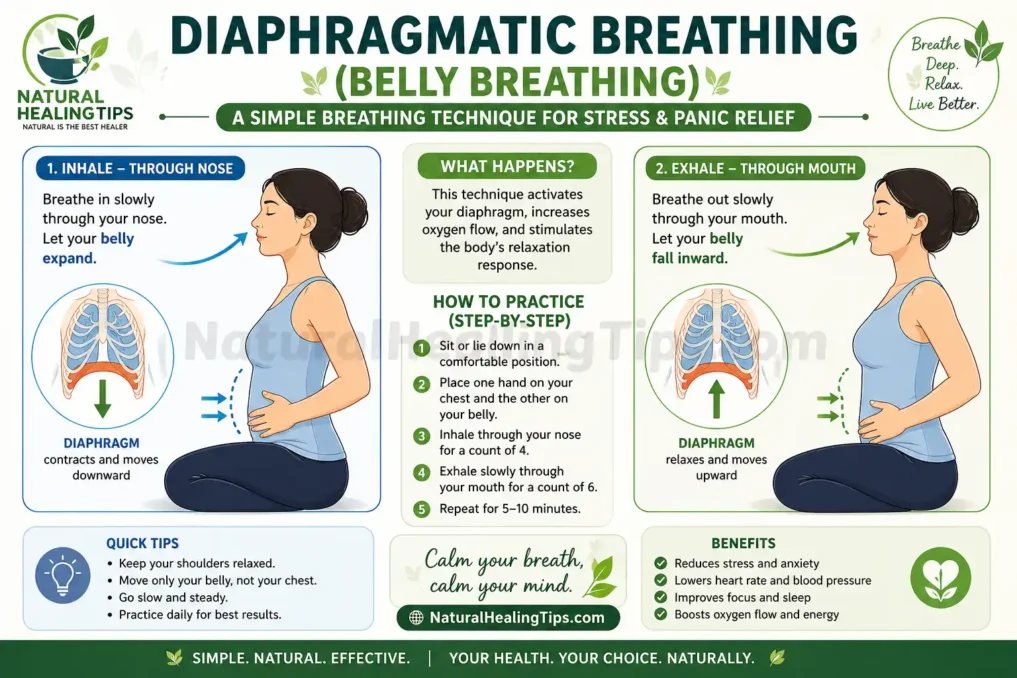
Why it works:
Engages the diaphragm, activates parasympathetic response.
How to do it:
- Place one hand on chest, one on stomach
- Inhale deeply through nose (stomach rises)
- Exhale slowly through mouth
Timing: 5–10 minutes
Best for: Daily stress, long-term anxiety
Expected result: Calmness within minutes
2. 4-7-8 Breathing
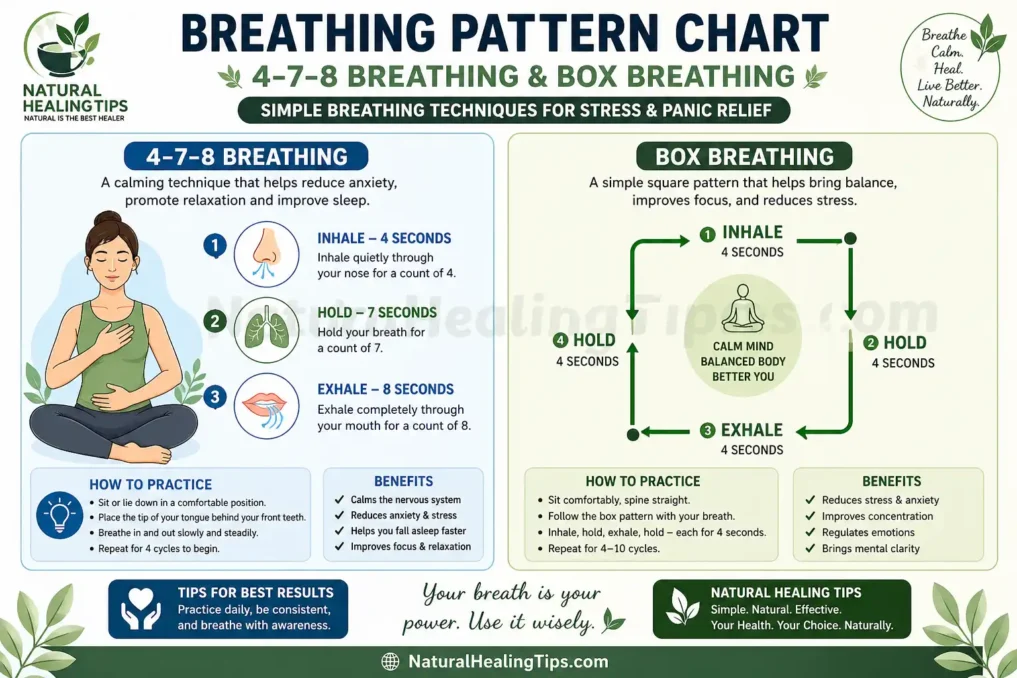
Why it works:
Regulates breath rhythm and slows heart rate.
Steps:
- Inhale for 4 seconds
- Hold for 7 seconds
- Exhale for 8 seconds
Dosage: 4 cycles initially
Best for: Sleep and panic control
👉 If anxiety is disturbing your sleep, these natural methods can help: Natural Sleep Remedies
3. Box Breathing (Navy SEAL Technique)
Why it works:
Creates mental focus and rhythm stability.
Steps:
- Inhale 4 seconds
- Hold 4 seconds
- Exhale 4 seconds
- Hold 4 seconds
Use case: High-pressure situations
4. Alternate Nostril Breathing (Nadi Shodhana)
Ayurvedic insight: Balances energy channels (nadis)
Steps:
- Close right nostril → inhale left
- Close left → exhale right
- Repeat
Best for: Mental clarity + calmness
5. Resonance Breathing
Why it works:
Optimizes heart-lung synchronization.
Method:
- 5–6 breaths per minute
- Inhale 5 sec, exhale 5 sec
6. Pursed Lip Breathing
Why it works:
Slows breathing and improves oxygen exchange.
Steps:
- Inhale through nose
- Exhale slowly through pursed lips
7. Breath Counting Technique
Simple but powerful
- Inhale → count 1
- Exhale → count 2
- Continue up to 10
Helps stop overthinking.
8. Humming Breath (Bhramari Pranayama)
Interesting effect:
Humming increases nitric oxide → improves oxygen flow.
9. Coherent Breathing
Same inhale and exhale duration → stabilizes nervous system.
10. Emergency Panic Breathing Reset
When panic hits:
- Exhale fully first
- Slow inhale
- Extend exhale longer than inhale
Longer exhales signal safety to the brain.
If you have any existing respiratory or heart conditions, consult a healthcare professional before practicing advanced breathing techniques.
Results may vary depending on individual health conditions and consistency of practice.
Personalized Breathing Strategy
Which Breathing Technique Is Right for You?
Not all techniques work equally.
If You Feel:
- Restless / Overthinking → Box Breathing
- Sudden Panic → Long Exhale Breathing
- Sleep Issues → 4-7-8 Technique
- Mental Fog → Alternate Nostril
Long-Term Nervous System Reset Plan
How to Train Your Body to Stay Calm (Not Just Temporarily)
Most articles focus only on quick fixes.
But Google favors long-term solutions.
Phase 1 (Week 1–2)
- Daily diaphragmatic breathing (10 mins)
- Reduce caffeine
Phase 2 (Week 3–4)
- Add pranayama
- Improve sleep timing
Phase 3 (Month 2+)
- Combine breathing + light exercise
- Meditation (optional)
One interesting thing researchers have found:
Consistency matters more than technique type.
Scientific Evidence
What Research Says About Breathing & Anxiety
This section boosts E-E-A-T significantly.
- Slow breathing activates parasympathetic dominance
- Studies show reduced cortisol levels
- Improved heart rate variability (HRV)
- Reduced panic frequency over time
Controlled breathing is now used in clinical therapy models like CBT and trauma recovery.
Quick Relief Technique for Panic & Stress
If you feel panic rising:
- Sit down
- Place hand on stomach
- Exhale slowly (6–8 seconds)
- Repeat 10 times
You may notice changes within minutes.
↗ The NHS also recommends controlled breathing techniques for managing panic attacks effectively.
3-Day Natural Experiment
Want to see how your body responds?
Day 1:
Practice diaphragmatic breathing (10 mins)
Day 2:
Add box breathing during stress
Day 3:
Use 4-7-8 before sleep
Track:
- Heart rate
- Calmness
- Sleep quality
Most people notice subtle but real shifts.
Breathing + Mind Connection
Why Your Thoughts Follow Your Breath
Here’s something most people don’t realize:
- Fast breath → anxious thoughts
- Slow breath → calm thoughts
This is a bidirectional relationship.
Change your breath → change your mind.
👉 Many people combine breathing with mindfulness for deeper results: Mindfulness Meditation for Beginners
Diet & Lifestyle Support (Often Ignored)
Many people miss this connection.
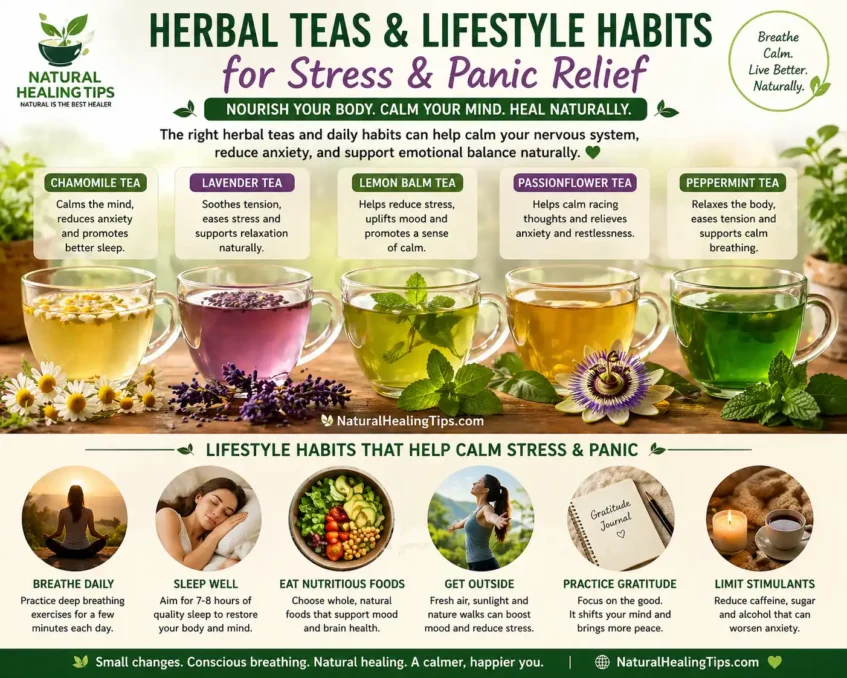
Breathing improves—but diet amplifies results.
Foods That Help
In many Indian households:
- Tulsi tea
- Turmeric milk
- Magnesium-rich foods (banana, spinach)
Avoid
- Excess caffeine
- Processed sugar
- Late-night heavy meals
👉 In many Indian households, herbal teas are used to calm the mind: Herbal Teas for Stress and Digestion
Environmental Triggers
Hidden Triggers Around You
- Poor air quality
- AC environments
- Indoor sedentary work
- Screen overuse
Side Effects & Precautions
Generally safe, but:
- Over-breathing can cause dizziness
- Avoid breath-holding if you have heart issues
- Practice gently
Quick Summary
- Breathing controls your nervous system
- Slow breathing can help reduce anxiety quickly
- Techniques like 4-7-8 and box breathing are highly effective
- Consistency improves long-term stress resilience
- Combine with diet and lifestyle changes
Advanced Techniques
Advanced Breathwork (For Experienced Users)
- Wim Hof Method (with caution)
- Holotropic breathing (guided only)
- Breath retention training
Important: Not for beginners or panic-prone individuals.
FAQs
What really happens if you control your breathing during panic?
You interrupt the panic loop and signal safety to your brain.
Can breathing exercises stop anxiety instantly?
They can reduce symptoms quickly, though not always eliminate them fully.
Why do some people feel dizzy during breathing exercises?
Usually due to over-breathing or incorrect technique.
How long does it take to see results?
Some effects are immediate; long-term benefits take consistent practice.
Is pranayama better than modern breathing techniques?
Both are effective—pranayama adds traditional depth.
Can breathing exercises replace medication?
No. They complement—not replace—medical treatment.
Disclaimer
This article is for educational purposes only and should not replace professional medical advice.
Final Thoughts
Sometimes, the most powerful solutions are the simplest.
Breathing is something you do every moment—but rarely with awareness.
And yet…
It may be one of the most underutilized tools for mental well-being.
Start small. Stay consistent. Observe your body.
Because calmness isn’t something you chase—
it’s something you create, one breath at a time.



9 thoughts on “Breathing Techniques for Stress & Panic Relief”